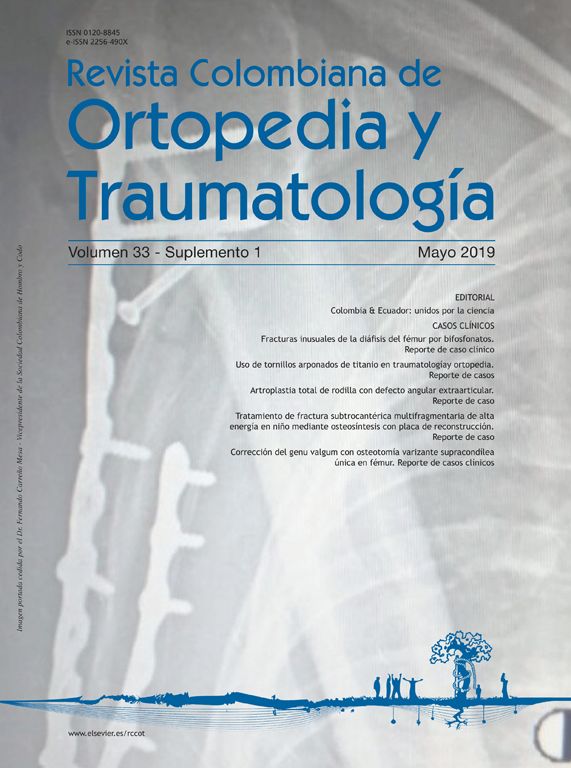
Unusual fractures of the femoral shaft produced by bisphosphonates use. Case report
DOI:
https://doi.org/10.1016/j.rccot.2019.03.001Keywords:
Bisphosphonates, Atypical fracture, Unusual fractureAbstract
There is a growing trend of atypical femur fractures in the current adult population. Treatment with bisphosphonates for more than 5 years may put patients at greater risk. The aim of this report is to demonstrate how surgical treatment with a rigid intramedullary device can maintain the position and length of the femur by improving stability and pain in nondisplaced fractures secondary to the use of bisphosphonates. A review is presented on the clinical case of a 77 year-old patient with moderate pain on walking of 2-months onset that improved with rest. After imaging tests were performed, it was decided to insert a rigid intramedullary device. The subsequent follow-up included a clinical assessment using the Lower Extremity Functional Scale (LEFS). Control X-rays were performed to determine the degree of consolidation during treatment, as well as the suspending of alendronate. Fixation was made with a second-generation gamma intramedullary nail, after which there was periodic monitoring and suspension of alendronate therapy. At 6 months post-operatively, the LEFS was applied, obtaining a 100% result.
Downloads
References
Chan SS, Rosenberg SZ, Chan K, Capeci C. Subtrochanteric femoral fractures in patients receiving long-term alendronate therapy: Imaging features. Amer J Radiol. 2010;194: 1581-6.
Wells GA, Cranney A, Peterson J, Boucher M, Shea B, Robinson V, et al. Alendronate for the primary and secondary prevention of osteoporotic fractures in postmenopausal women. Cochrane Database Syst Rev. 2008. CD001155.
Black JD, Kancherla VK, DeLong WG Jr. A review of atypical femoral fractures from a tertiary care teaching hospital: An alarming trend? J Orthop Trauma. 2016;30:182-8, http://dx.doi.org/10.1097/BOT.0000000000000539
Kwek EB, Goh SK, Koh JS, Png MA, Howe TS. An emerging pattern of subtrochanteric stress fractures: A long-term complication of alendronate therapy? Injury. 2008;39:224-31.
Abrahamsen B, Eiken P, Eastell R. Subtrochanteric and diaphyseal femur fractures in patients treated with alendronate: A register-based national cohort study. J Bone Miner Res. 2009;24:1095-102.
Gari E, de la Pena˜ O, Solano AL. Resultados del tratamiento de fracturas inestables con clavo cefalomedular bloqueado. Rev Col de Or Tra. 2008;22:60-6.
Odvina CV, Zerwekh JE, Rao DS, Maalouf N, Gottschalk FA, Pak CY. Severely suppressed bone turnover: A potential complication of alendronate therapy. J Clin Endocrinol Metab. 2005;90:1294-301.
Rodan GA, Reszka AA. Osteoporosis and bisphosphonates. J Bone Joint Surg Am. 2003;85A suppl 3:8-12.
Capeci CM, Tejwani NC. Bilateral low-energy simultaneous or sequential femoral fractures in patients on long-term alendronate therapy. J Bone Joint Surg Am. 2009;91:2556-61.
Morris CD, Einhorn TA. Bisphosphonates in orthopaedic surgery. J Bone Joint Surg Am. 2005;87:1609-18.
Mendoza J. Fracturas complejas del fémur y su tratamiento: Ortotips. 2012;8:171-8.
Black DM, Cummings SR, Karpf DB, Cauley JA, Thompson DE, Nevitt MC, et al. Randomised trial of effect of alendronate on risk of fracture in women with existing vertebral fractures. Fracture Intervention Trial Research Group. Lancet. 1996;348:1535-41.
Espinosa H. Tratamiento actual de las fracturas de fémur. Orthotips. 2012;8:165-70.
Nieto L, Zamorano A. Consideraciones epidemiológicas de las fracturas del fémur proximal. Ortho-tips. 2012;8:135-9.
Abrahamsen B, Eiken P, Eastell R. Cumulative alendronate dose and the long-term absolute risk of subtrochanteric and diaphyseal femur fractures: A register-based national cohort analysis. J Clin Endocrinol Metab. 2010;95:5258-65.
Gates BJ, Sonnett TE, Duvall CA, Dobbins EK. Review of osteoporosis pharmacotherapy for geriatric patients. Am J Geriatr Pharmacother. 2009;7:293-323.
Hodsman AB, Hanley DA, Josse R. Do bisphosphonates reduce the risk of osteoporotic fractures? An evaluation of the evidence to date. CMAJ. 2002;166:1426-30.
Cheung RK, Leung KK, Lee KC, Chow TC. Sequential nontraumatic femoral shaft fractures in a patient on long-term alendronate. Hong Kong Med J. 2007;13:485-9.
Spivacow FR, Sánchez A. Epidemiology, costs, and burden of osteoporosis in Argentina, 2009. Arch Osteoporos. 2010;5:1-6.
Goh SK, Yang KY, Koh JS, Wong MK, Chua SY, Chua DT, et al. Subtrochanteric insufficiency fractures in patients on alendronate therapy: A caution. J Bone Joint Surg Br. 2007;89:349-53.
Downloads
Published
How to Cite
Issue
Section
License
Copyright (c) 2025 Sociedad Colombiana de Cirugía Ortopédica y Traumatología.

This work is licensed under a Creative Commons Attribution 4.0 International License.
| Article metrics | |
|---|---|
| Abstract views | |
| Galley vies | |
| PDF Views | |
| HTML views | |
| Other views | |