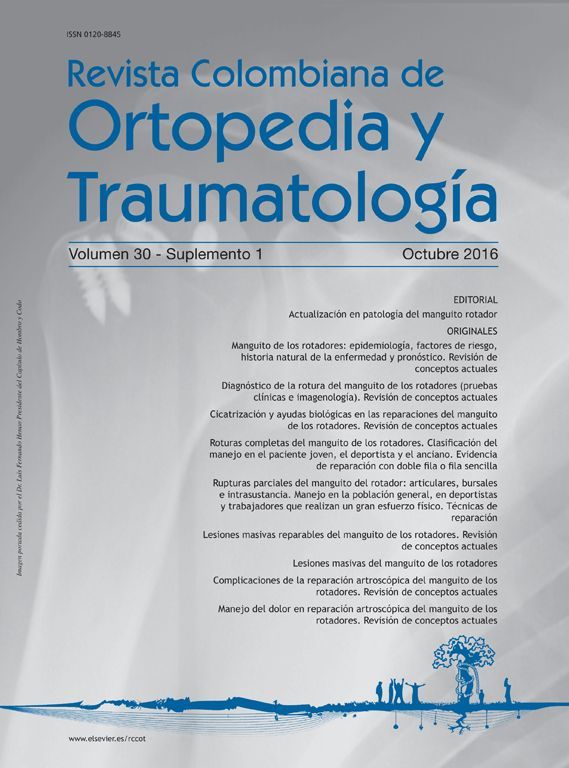
Pain management in arthroscopic rotator cuff repair. Current concepts
DOI:
https://doi.org/10.1016/j.rccot.2016.09.010Keywords:
Rotator Cuff, Pain Management, Arthroscopic Repair, Multimodal AnalgesiaAbstract
Although arthroscopic rotator cuff repair offers many advantages over open repair as are the least trauma to the deltoid, reduction in the rate of postoperative shoulder stiffness and better postoperative rehabilitation with lower morbidity, it remains a painful procedure, especially during the first 48 hours postoperatively. The postoperative pain management intervention should always be focused on multimodal analgesia defined as the use of various techniques and analgesic drugs with different mechanisms of peripheral action and/or central nervous system with synergistic effect, greater analgesic efficacy, compared with their single action.
Downloads
References
Levy O, Venkateswaran B, Even T, Ravenscroft M, Copeland S. Mid-term clinical and sonographic outcome of arthroscopic repair of the rotator cuff. J Bone Joint Surg Br. 2008;90:1341-7.
Oh CH, Oh JH, Kim SH, Cho JH, Yoon JP, Kim JY. Effectiveness of subacromial anti-adhesive agent injection after arthroscopic rotator cuff repair: prospective randomized comparison study. Clin Orthop Surg. 2001;3:55-61.
Severud EL, Ruotolo C, Abbott DD, Nottage WM. All arthroscopic versus mini-open rotator cuff repair: a long-term retrospective outcome comparison. Arthroscopy. 2003;19:234-8.
Bang SR, Yu SK, Kim TH. Can gabapentin help reduce postoperative pain in arthroscopic rotator cuff repair? A prospective, randomized, double-blind study. Arthroscopy. 2010;26:S106-11.
Oh JH, Kim WS, Kim JY, Gong HS, Rhee KY. Continuous intralesional infusion combined with interscalene block was effective for postoperative analgesia after arthroscopic shoulder surgery. J Should Elbow Surg. 2007;16:295-9.
Koltka K, Do˘gruel B, Sentürk M, Atalar AC, Küc¸ükay S, Pembeci K. Postoperative analgesia for arthroscopic rotator cuff surgery: a comparison between subacromial and interscalene levobupivacaine. Agri. 2011;23:7-12.
Kehlet H, Wilmore D. Multimodal strategies to improve surgical outcome. Am J Surg. 2002;183:630-41.
Colvin AC, Egorova N, Harrison AK, Moskovitz A, Flatow EL. National trends in rotator cuff repair. J Bone Joint Surg Am. 2012;94:227-33.
Uquillas CA, Capogna BM, Rossy WH, Mahure SA, Rokito AS. Postoperative pain control after arthroscopic rotator cuff repair. J Shoulder Elbow Surg. 2016;25:1204-13.
Scott MJ, Baldini G, Fearon KCH, Feldheiser A, Feldman LS, Gan TJ, et al. Enhanced Recovery After Surgery (ERAS) for gastrointestinal surgery, part 1: pathophysiological considerations. Acta Anaesthesiol Scand. 2015;59:1212-31.
Joshi GP. Multimodal analgesia techniques and postoperative rehabilitation. Anesthesiol Clin North Am. 2005;23:185-202.
Parvizi J, Bloomfield MR. Multimodal pain management in orthopedics: implications for joint arthroplasty surgery. Orthopedics. 2013;36:7-14.
Egbert LD, Battit GE, Welch CE, Bartlett MK. Reduction of postoperative pain by encouragement and instruction of patients. A study of doctor- patient rapport. N Engl J Med. 1964;270:825-7.
Langer EJ, Janis IL, Wolfer JA. Reduction of psychological stress in surgical patients. J Exp Soc Psychol. 1975;11:155-65.
Crowe J, Henderson J. Pre-arthroplasty rehabilitation is effective in reducing hospital stay. Can J Occup Ther. 2003;70:88-96.
Patanwala AE, Jarzyna DL, Miller MD, Erstad BL. Comparison of opioid requirements and analgesic response in opioid-tolerant versus opioid-naïve patients after total knee arthroplasty. Pharmacoterapy. 2008;28:1453-60.
McDaid C, Maund E, Rice S, Wright K, Jenkins BJ, Woolacott N. Paracetamol and selective and non-selective non-steroidal anti-inflammatory drugs (NSAIDs) for the reduction of morphinerelated side effects after major surgery: A systematic review. Health Technol Assess. 2010;14:1-153.
Ong CK, Seymour RA, Lirk P, Merry AF. Combining paracetamol (acetaminophen) with nonsteroidal anti-inflammatory drugs: A qualitative systematic review of analgesic efficacy for acute postoperative pain. Anesth Analg. 2010;110:1170-9.
Brett CN, Barnett SG, Pearson J. Postoperative plasma paracetamol levels following oral or intravenous paracetamol administration: A double-blind randomized controlled trial. Anaesth Intensive Care. 2012;40:166-71.
Pettersson PH, Jakobsson J, Owall A. Intravenous acetaminophen reduced the use of opioids compared with oral administration after coronary artery bypass grafting. J Cardiothorac Vasc Anesth. 2005;19:306-9.
Tramer MR, Williams JE, Carroll D, Wiffen PJ, Moore RA, McQuay HJ. Comparing analgesic efficacy of non-steroidal antiinflammatory drugs given by different routes in acute and chronic pain: A qualitative systematic review. Acta Anaesthesiol Scand. 1998;42:71-9.
Dodwell ER, Latorre JG, Parisini E, Zwettler E, Chandra D, Mulpuri K. NSAID exposure and risk of nonunion: A metaanalysis of case-control and cohort studies. Calcif Tissue Int. 2010;87:193-202.
U.S. Food and Drug Administration: Information for Healthcare Professionals: Non-Selective Non-Steroidal AntiInflamatory Drugs (NSAIDs)*. Disponible en: http://www.fda.gov/Drugs/DrugSafety/PostmarketDrugSafetyInformationforPatientsandProviders/DrugSafetyInformationforHeathcareProfessionals/ucm085282.htm.[acceso: 30 de octubre de 2014].
Chou R, Gordon DB, de Leon-Casasola OA, Rosenberg JM, Bickler S, Brennan T. Management of Postoperative Pain: A Clinical Practice Guideline From the American Pain Society, the American Society of Regional Anesthesia and Pain Medicine, and the American Society of Anesthesiologists’ Committee on Regional Anesthesia, Executive Committee, and Administrative Council. J Pain. 2016;17:131-57.
Tamura S, Watanabe M, Kanbara K, Yanagawa T, Watanabe K, Otsuki Y. Expression and distribution of GABAergic system in rat knee joint synovial membrane. Histol Histopathol. 2009;24:1009-19.
Zhang J, Ho KY, Wang Y. Efficacy of pregabalin in acute postoperative pain: A meta-analysis. Br J Anaesth. 2011;106:454-62.
Straube S, Derry S, Moore RA, Wiffen PJ, McQuay HJ. Single dose oral gabapentin for established acute postoperative pain in adults. Cochrane Database Syst Rev. 2010:CD008183. May 12.
Mathiesen O, Moiniche S, Dahl JB. Gabapentin and postoperative pain: A qualitative and quantitative systematic review, with focus on procedure. BMC Anesthesiol. 2007;7:6.
Adam F, Menigaux C, Sessler D, Chauvin M. A single preoperative dose of gabapentin (800 milligrams) does not augment postoperative analgesia in patients given interescalene brachial plexus blocks for arthroscopic shoulder surgery. Anesth Analg. 2006;103:1278-82.
Kukkar A, Bali A, Singh N, Jaggi AS. Implications and mechanism of action of gabapentin in neuropathic pain. Arch Pharm Res. 2013;36:237-51.
Hadzic A, Williams BA, Karaca PE, Hobeika P, Unis G, Dermksian J, et al. For outpatient rotator cuff surgery, nerve block anesthesia provides superior same-day recovery over general anesthesia. Anesthesiology. 2005;102:1001-7.
Ilfeld BM, Vandenborne K, Duncan PW, Sessler DI, Enneking FK, Shuster JJ, et al. Ambulatory continuous interscalene nerve blocks decrease the time to discharge readiness after total shoulder arthroplasty: a randomized, triple-masked, placebocontrolled study. Anesthesiology. 2006;105:999-1007.
Krone SC, Chan VW, Regan J, Peng P, Poate EM, McCartney C, et al. Analgesic effects of low- dose ropivacaine for interscalene brachial plexus block for outpatient shoulder surgery-a dosefinding study. Reg Anesth Pain Med. 2001;26:439-43.
Gelfand HJ, Ouanes JP, Lesley MR, Ko PS, Murphy JD, Sumida SM, et al. Analgesic efficacy of ultrasound-guided regional anesthesia: a meta-analysis. J Clin Anesth. 2011;23:90-6.
Singh S, Goyal R, Upadhyay KK, Sethi N, Sharma RM, Sharma A. An evaluation of brachial plexus block using a nerve stimulator versus ultrasound guidance: a randomized controlled trial. J Anaesthesiol Clin Pharmacol. 2015;31:370-4.
D’Alessio JG, Rosenblum M, Shea KP, Freitas DG. A retrospective comparison of interscalene block and general anesthesia for ambulatory surgery shoulder arthroscopy. Reg Anesth. 1995;20:62.
Chelly JE, Greger J, Al Samsam T, Gebhard R, Masson M, Matuszczak M, et al. Reduction of operating and recovery room times and overnight hospital stays with interscalene blocks as sole anesthetic technique for rotator cuff surgery. Minerva Anestesiol. 2001;67:613-9.
Ahsan ZS, Carvalho B, Yao J. Incidence of failure of continuous peripheral nerve catheters for postoperative analgesia in upper extremity surgery. J Hand Surg Am. 2014;39:324-9.
Bjørnholdt KT, Jensen JM, Bendtsen TF, Søballe K, Nikolajsen L. Local infiltration analgesia versus continuous interscalene brachial plexus block for shoulder replacement pain: a randomized clinical trial. Eur J Orthop Surg Traumatol. 2015;25:1245-52.
Palte HD. In pursuit of interscalene safety. Br J Anaesth. 2014;112:938-9.
Boss AP, Maurer T, Seiler S, Aeschbach A, Hintermann B, Strebel S. Continuous subacromial bupivacaine infusion for postoperative analgesia after open acromioplasty and rotator cuff repair: preliminary results. J Shoulder Elbow Surg. 2004;13:630-4.
Matsen FA 3rd, Papadonikolakis A. Published evidence demonstrating the causation of glenohumeral chondrolysis by postoperative infusion of local anesthetic via a pain pump. J Bone Joint Surg Am. 2013;95:1126-34.
Hadzic A, Hobeika P, Choi J, Lin E, Littwin S, Shariat AN, et al. Continuous interscalene block in patients having outpatient rotator cuff repair surgery: a prospective randomized trial. Anesth Analg. 2013;117:1485-92.
Liu SS, Zayas VM, Gordon MA, Beathe JC, Maalouf DB, Paroli L, et al. A prospective, randomized, controlled trial comparing ultrasound versus nerve stimulator guidance for interscalene block for ambulatory shoulder surgery for postoperative neurological symptoms. Anesth Analg. 2009;109:265-71.
Halaszynski TM. Ultrasound brachial plexus anesthesia and analgesia for upper extremity surgery: essentials of our current understanding. Curr Opin Anesthesiol. 2011;24:581-91.
Smith HM, Duncan CM, Hebl JR. Clinical utility of low-volume ultrasound-guided interscalene blockade. Contraindications reconsidered. J Ultrasound Med. 2009;28:1251-8.
Liu SS, Gordon MA, Shaw PM, Wilfred S, Shetty T, Yadeau JT. A prospective clinical registry of ultrasound-guided regional anesthesia for ambulatory shoulder surgery. Anesth Analg. 2010;111:617-23.
Ro YJ, Yang HS, Choi WJ, Park HS, Kim HJ, Koh WU. A randomized controlled trial comparing continuous supraclavicular and interscalene brachial plexus blockade for open rotator cuff surgery. Anaesthesia. 2016;71:692-9.
Price DJ. The Shoulder Block: a new alternative to interscalene brachial plexus blockade for the control of postoperative shoulder pain. Anesth Intensive Care. 2007;35:575-81.
Ritchie ED, Tong D, Chung F, Norris AM, Miniaci A, Vairavanathan SD. Suprascapular nerve block for postoperative pain relief in arthroscopic shoulder surgery: a new modality. Anesth Analg. 1997;84:1306-12.
Checcucci G, Allegra A, Bigazzi P, Gianesello L, Ceruso M, Gritti G. A new technique for regional anesthesia for arthroscopic shoulder surgery based on a suprascapular nerve block and an axillary nerve block: an evaluation of the first results. Arthroscopy. 2008;24:689-96.
Nam Y-S, Jeong J-J, Han S-H, Park S-E, Lee S-M, Kwon M-J, et al. An anatomic and clinical study of the suprascapular and axillary nerve blocks for shoulder arthroscopy. J Shoulder Elbow Surg. 2011;20:1061-8.
Cho C-H, Song K-S, Min B-W, Lee K-J, Lee EHY-C, Lee Y-K. Multimodal approach to postoperative pain control in patients undergoing rotator cuff repair. Knee Surg Sports Traumatol Arthrosc. 2011;19:1744-8.
Colwell CW Jr. The use of the pain pump and patient-controlled analgesia in joint reconstruction. Am J Orthop. 2004;33:10-2.
Sinatra RS, Torres J, Bustos AM. Pain management after major orthopaedic surgery: current strategies and new concepts. J Am Acad Orthop Surg. 2002;10:117-29.
Zywiel MG, Stroh DA, Lee SY, Bonutti PM, Mont MA. Chronic opioid use prior to total knee arthroplasty. J Bone Joint Surg Am. 2011;93:1988-9.
Downloads
Published
How to Cite
Issue
Section
License
Copyright (c) 2025 Sociedad Colombiana de Cirugía Ortopédica y Traumatología.

This work is licensed under a Creative Commons Attribution 4.0 International License.
| Article metrics | |
|---|---|
| Abstract views | |
| Galley vies | |
| PDF Views | |
| HTML views | |
| Other views | |