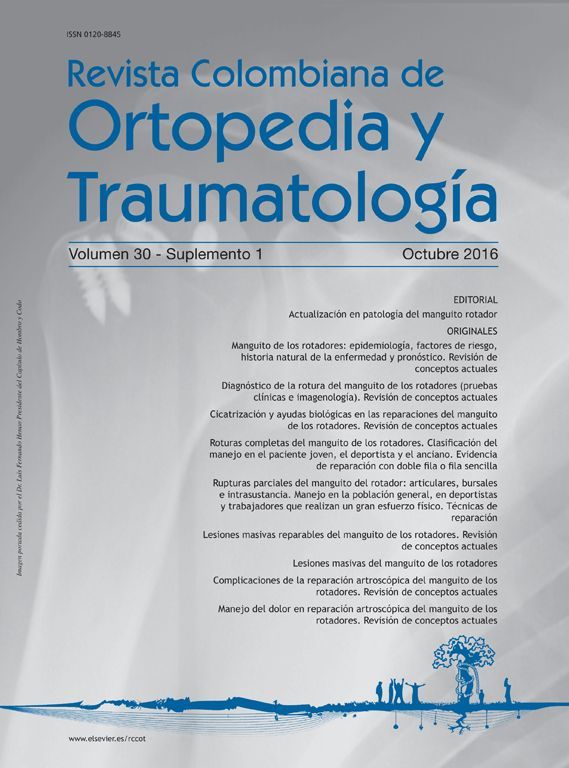
Repairable massive rotator cuff injuries. Current concepts
DOI:
https://doi.org/10.1016/j.rccot.2016.09.006Keywords:
Repairable Massive Rotator Cuff Injuries, Surgical Technique, Patient Selection, Rehabilitation ProtocolAbstract
Massive rotator cuff injuries are one of the biggest challenges today, mainly in defining treatment. Determine which constitutes a massive reparable injury is clinically and radiologically difficult, and therefore is often arbitrary. The results with nonsurgical conservative treatment are inconsistent and there is variability of successful outcomes with surgical treatment. Diagnostic imaging can confirm the diagnosis of rupture, helping to define the size and characteristics of the injurie, information necessary to establish both the treatment plan and prognosis of the injurie. The success of surgery treatment is related to a proper selection of the patient and the most appropriate surgical technique on an individual basis. Currently repair techniques have evolved to a point of being able to repair most of these breakups. Often associated pathology and rehabilitation of these patients already has a defined protocol.
Downloads
References
Habermeyer P, Magosch P, Lichtenberg S. Classifications and scores of the shoulder. En: Classifications and Scores of the Shoulder. Heidelberg: Springer; 2006.
Ellman H. Diagnosis and treatment of incomplete rotator cuff tears. Clin Orthop Relat Res. 1990;254:64-74.
Harryman DT 2nd, Mack LA, Wang KY, Jackins SE, Richardson ML, Matsen FA 3rd. Repairs of the rotator cuff. Correlation of functional results with integrity of the cuff. J Bone Joint Surg Am. 1991;73:982-9.
Dines DM, Moynihan DP, Dines J, McCann P. Irreparable rotator cuff tears: what to do and when to do it; the surgeon’s dilemma. J Bone Joint Surg Am. 2006;88:2294-302.
Harreld KL, Puskas BL, Frankle MA. Massive rotator cuff tears without arthropathy: when to consider reverse shoulder arthroplasty. Instr Course Lect. 2012;61:143-56.
Cofield RH, Parvizi J, Hoffmeyer PJ, Lanzer WL, Ilstrup DM, Rowland CM. Surgical repair of chronic rotator cuff tears. A prospective long-term study. J Bone Joint Surg Am. 2001;83-A:71-7.
Nobuhara K, Hata Y, Komai M. Surgical procedure and results of repair of massive tears of the rotator cuff. Clin Orthop Relat Res. 1994;304:54-9.
Tauro JC. Arthroscopic ‘‘interval slide’’ in the repair of large rotator cuff tears. Arthroscopy. 1999;15:527-30.
Zumstein MA, Jost B, Hempel J, Hodler J, Gerber C. The clinical and structural long-term results of open repair of massive tears of the rotator cuff. J Bone Joint Surg Am. 2008;90:2423-31.
Lo IKY, Burkhart SS. The interval slide in continuity: A method of mobilizing the anterosuperior rotator cuff without disrupting the tear margins. Arthroscopy. 2004;20:435-41.
Elhassan B, Endres NK, Higgins LD, Warner JJP. Massive irreparable tendon tears of the rotator cuff: salvage options. Instr Course Lect. 2008;57:153-66.
Neri BR, Chan KW, Kwon YW. Management of massive and irreparable rotator cuff tears. J Shoulder Elb Surg. 2009;18:808-18.
Walch G, Edwards TB, Boulahia A, Nové-Josserand L, Neyton L, Szabo I. Arthroscopic tenotomy of the long head of the biceps in the treatment of rotator cuff tears: clinical and radiographic results of 307 cases. J Shoulder Elbow Surg. 2005;14:238-46.
Burkhart SS. Arthroscopic treatment of massive rotator cuff tears. Clinical results and biomechanical rationale. Clin Orthop Relat Res. 1991;267:45-56.
Park JG, Cho NS, Song JH, Baek JH, Rhee YG. Long-term outcome of tuberoplasty for irreparable massive rotator cuff tears: is tuberoplasty really applicable? J Shoulder Elbow Surg. 2016;25:224-31.
Boileau P, McClelland WB, Rumian AP. Massive irreparable rotator cuff tears: how to rebalance the cuff-deficient shoulder. Instr Course Lect. 2014;63:71-83.
Thès A, Hardy P, Bak K. Decision-making in massive rotator cuff tear. Knee Surg Sport Traumatol Arthrosc Off J. 2015;23:449-59.
Sharma P, Morrison WB, Cohen S. Imaging of the shoulder with arthroscopic correlation. Clin Sports Med. 2013;32:339-59.
Nazarian LN, Jacobson JA, Benson CB, Bancroft LW, Bedi A, McShane JM, et al. Imaging algorithms for evaluating suspected rotator cuff disease: Society of Radiologists in Ultrasound consensus conference statement. Radiology. 2013;267:589-95.
Hamada K, Yamanaka K, Uchiyama Y, Mikasa T, Mikasa M. A radiographic classification of massive rotator cuff tear arthritis. Clin Orthop Relat Res. 2011;469:2452-60.
Boileau P, McClelland WBJ, Rumian AP. Massive irreparable rotator cuff tears: how to rebalance the cuff-deficient shoulder. Instr Course Lect. 2014;63:71-83.
Anderson MW, Brennan C, Mittal A. Imaging evaluation of the rotator cuff. Clin Sports Med. 2012;31:605-31.
Yablon CM, Bedi A, Morag Y, Jacobson JA. Ultrasonography of the shoulder with arthroscopic correlation. Clin Sports Med. 2013;32:391-408.
Roy J-S, Braën C, Leblond J, Desmeules F, Dionne CE, MacDermid JC, et al. Diagnostic accuracy of ultrasonography, MRI and MR arthrography in the characterisation of rotator cuff disorders: a systematic review and meta-analysis. Br J Sports Med. 2015;49:1316-28.
Yablon CM, Bedi A, Jacobson JA. U Ultrasonography of the shoulder with arthroscopic correlation. Clin Sports Med. 2013;32:391-408.
Lenza M, Buchbinder R, Takwoingi Y, Johnston RV, Hanchard NC, Faloppa F. Magnetic resonance imaging, magnetic resonance arthrography and ultrasonography for assessing rotator cuff tears in people with shoulder pain for whom surgery is being considered. En: Cochrane Database of Systematic Reviews. Chichester, UK: John Wiley & Sons; 2013.
Jain NB, Collins J, Newman JS, Katz JN, Losina E, Higgins LD. Reliability of magnetic resonance imaging assessment of rotator cuff: the ROW study. PM R. 2015;7:245-54.e3, quiz 254.
Dwyer T, Razmjou H, Henry P, Gosselin-Fournier S, Holtby R. Association between pre-operative magnetic resonance imaging and reparability of large and massive rotator cuff tears. Knee Surg Sport Traumatol Arthrosc. 2015;23:415-22.
Goutallier D, Postel JM, Bernageau J, Lavau L, Voisin MC. Fatty muscle degeneration in cuff ruptures. Pre- and postoperative evaluation by CT scan. Clin Orthop Relat Res. 1994;304:78-83.
Osti L, Buda M, Del Buono A. Fatty infiltration of the shoulder: diagnosis and reversibility. Muscles Ligaments Tendons J. 2013;3:351-4.
Gerber C. Fatty degeneration of the muscles of the rotator cuff: Assessment by computed tomography versus magnetic. 1999;8:599-605.
Schiefer M, Mendonc¸a R, Magnanini MM, Fontenelle C, Pires Carvalho AC, Almeida M, et al. Intraobserver and interobserver agreement of Goutallier classification applied to magnetic resonance images. J Shoulder Elb Surg. 2015;24:1314-21.
Melis B, DeFranco MJ, Chuinard C, Walch G. Natural history of fatty infiltration and atrophy of the supraspinatus muscle in rotator cuff tears. Clin Orthop Relat Res. 2010;468:1498-505.
Zanetti M, Gerber C, Hodler J. Quantitative assessment of the muscles of the rotator cuff with magnetic resonance imaging. Invest Radiol. 1998;33:163-70.
Rulewicz GJ, Beaty S, Hawkins RJ, Kissenberth MJ. Supraspinatus atrophy as a predictor of rotator cuff tear size: an MRI study utilizing the tangent sign. J Shoulder Elb Surg. 2013;22:e6-10.
Kissenberth MJ, Rulewicz GJ, Hamilton SC, Bruch HE, Hawkins RJ. A positive tangent sign predicts the repairability of rotator cuff tears. J Shoulder Elb Surg. 2014;23:1023-7.
Loew M, Magosch P, Lichtenberg S, Habermeyer P, Porschke F. How to discriminate between acute traumatic and chronic degenerative rotator cuff lesions: an analysis of specific criteria on radiography and magnetic resonance imaging. J Shoulder Elb Surg/Am Shoulder Elb Surg. 2015;24:1685-93.
Lecouvet FE, Simoni P, Koutaïssoff S, Van de Berg BC, Malghem J, Dubuc J-E. Multidetector spiral CT arthrography of the shoulder. Eur J Radiol. 2008;68:120-36.
Burkhart SS. Arthroscopic rotator cuff repair: Indications and technique. Oper Tech Sports Med. 1997;6:123-32.
Sørensen AK, Bak K, Krarup AL, Thune CH, Nygaard M, Jørgensen U, et al. Acute rotator cuff tear: Do we miss the early diagnosis? A prospective study showing a high incidence of rotator cuff tears after shoulder trauma. J Shoulder Elb Surg. 2007;16:174-80.
Green A. Chronic massive rotator cuff tears: evaluation and management. J Am Acad Orthop Surg. 2003;11:321-31.
Lafosse L, Van Raebroeckx A, Brzoska R. A new technique to improve tissue grip: ‘‘the lasso-loop stitch.’’. Arthroscopy. 2006;22:1246, e1-e3.
Jones CK, Savoie FH. Arthroscopic repair of large and massive rotator cuff tears. Arthroscopy. 2003;19:564-71.
Wolf EM, Pennington WT, Agrawal V. Arthroscopic side-to-side rotator cuff repair. Arthroscopy. 2005;21:881-7.
Warner JP, Krushell RJ, Masquelet A, Gerber C. Anatomy and relationships ofthe suprascapular nerve: anatomical constraints to mobilization of the supraspinatus and infraspinatus muscles in the management of massive rotator-cuff tears. J Bone Joint Surg Am. 1992;74:36-45.
Albritton MJ, Graham RD, Richards RS, Basamania CJ. An anatomic study of the effects on the suprascapular nerve due to retraction of the supraspinatus muscle after a rotator cuff tear. J Shoulder Elbow Surg. 2003;12:497-500.
Savoie FH, Miller CD. Suprascapular nerve decompression through a superior approach. J Shoulder Elb Surg. 1996;5:S53.
Barber FA. Percutaneous arthroscopic release of the suprascapular nerve. Arthroscopy. 2008;24:236, e1-e4.
Lafosse L, Tomasi A. Technique for endoscopic release of suprascapular nerve entrapment at the suprascapular notch. Tech Shoulder Elb Surg. 2006;7:1-6.
Gaunt BW, Shaffer MA, Sauers EL, Michener LA, McCluskey GM, Thigpen C. The American Society of Shoulder and Elbow Therapists’ consensus rehabilitation guideline for arthroscopic anterior capsulolabral repair of the shoulder. J Orthop Sports Phys Ther. 2010;40:155-68.
Downloads
Published
How to Cite
Issue
Section
License
Copyright (c) 2025 Sociedad Colombiana de Cirugía Ortopédica y Traumatología.

This work is licensed under a Creative Commons Attribution 4.0 International License.
| Article metrics | |
|---|---|
| Abstract views | |
| Galley vies | |
| PDF Views | |
| HTML views | |
| Other views | |