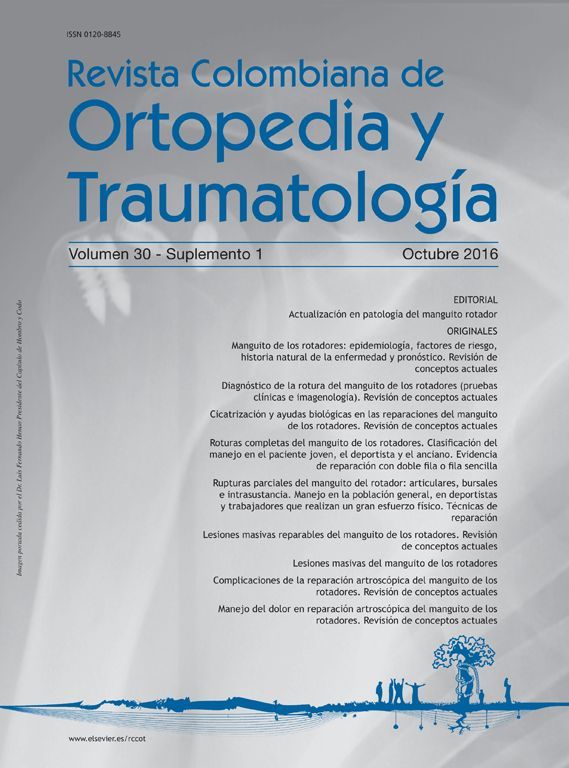
Rotator cuff complete tears. Classification and management in young patient, elderly and sportsman. Evidence of double row versus simple row repairs
DOI:
https://doi.org/10.1016/j.rccot.2016.09.011Keywords:
Rotator Cuff Tears, Single Row Repair, Double Row Repair, Risk FactorsAbstract
About 4.5 million people in the US have some type of rotator cuff injury. About 300,000 to 400,000 surgeries are performed each year in the United States. The complete rupture of the rotator cuff tendons is the most common pathology in the shoulder joint. This pathology increases with age even in the asymptomatic population. Work activity, lifestyle, recreation, pain and functional limitation are determining factors for the proper management of this condition. Injuries in adults are mostly kind traumatic and surgical management should be the choice to avoid tendon retraction, muscle atrophy and poor performance in the future. Complete rotator cuff injuries in athletes usually need surgical repair. But nevertheless, the athlete may find it difficult to return to its previous level of sports activities after presenting this type of injury. No study has shown that clinical outcomes are different whether the repair is performed by single or double row techniques.
Downloads
References
Goutallier D, Postel JM, Bernageau J, Lavau L, Voisin MC. Fatty muscle degeneration in cuff ruptures. Pre- and postoperative evaluation by CT scan. Clin Orthop Relat Res. 1994;304:78-83.
Fuchs B, Weishaupt D, Zanetti M, Hodler J, Gerber C. Fatty degeneration of the muscle of the rotator cuff: assessment by computed tomography versus magnetic resonance imaging. J Shoulder Elbow Surg. 1999;8:599-605.
Ellman H. Rotator cuff disorders. En: Ellman H, Gartsman GM, editores. Arthroscopic shoulder surgery and related disorders. Philadelphia: Lea and Febiger; 1993. p. 98-119.
Sher JS, Uribe JW, Posada A, Murphy BJ, Zlatkin MB. Abnormal findings on magnetic resonance images of asymptomatic shoulders. J Bone Joint Surg Am. 1995;77:10-6.
Matsen FA. Rotator-cuff failure. N Engl J Med. 2008;358:2138-47.
DeOrio JK, Cofield RH. Results of a second attempt at surgical repair of a failed initial rotator cuff repair. J Bone Joint Surg Am. 1984;66:563-7.
Harryman DT, Mack LA, Wang K, Jackins SE, Richardson ML, Matsen FA. Repairs of the rotator cuff. Correlation of functional results with in 8. Davidson J, Burkhart SS. The geometric classification of rotator cuff tears: system linking tear pattern to treatment and prognosis. Arthroscopy. 2010;26:417-24.
Bayne O, Bateman J. Long-term results of surgical repair of full-thickness rotator cuff tears. En: Bateman JE, Welsh R, editores. Surgery of the shoulder. Philadelphia: CV Mosby; 1984. p. 167-71.
Hamada K, Yamanaka K, Uchiyama Y, Takahiro M, Motohiko M. A radiographic classification of massive rotator cuff tears arthritis. Clin Orthop Relat Res. 2011;469:2452-60.
Patte D. Classification off rotator cuff lesions. Clin Orthop Relat Res. 1990;254:81-6.
Arce G, Bak K, Bain G, Calvo E, Ejnisman B, Di Giacomo G, et al. Management of disorders of the rotator cuff: proceedings of the ISAKOS upper extremity committee consensus meeting. Arthroscopy. 2013;29:1840-50.
Boileau P, Brassart N, Watkinson DJ, Carles M, Hatzidakis AM, Krishnan SG. Arthroscopic repair of full-thickness tears of the supraspinatus: Does the tendon really heal? J Bone Joint Surg Am. 2005;87:1229-40.
Lin EC, Mall NA, Dhawan A, Sherman SL, McGill KC, Provencher MT, et al. Arthroscopic primary rotator cuff repairs in patients aged younger than 45 years. Arthroscopy. 2013;29:811-7.
Lazarides A, Alentorn-Geli E, Choi J, Stuart J, Garrigues G, Taylor D. Rotator cuff tears in young patients: a different disease than rotator cuff tears in elderly patients. J Shoulder Elbow Surg. 2015;24:1834-43.
Mackechni E, Chahal J, Wassertein D, Theodoropulus J, Henry P, Dwyer T. Repair of full-thickness rotator cuff tears in patients aged younger than 55 years. Arthroscopy. 2014;30:1366-71.
Millet P, Warth R. Posterosuperior rotator cuff tears: Classification, pattern recognition and treatment. J Am Acad Orthop Surg. 2014;22:521-34.
Jacquot A, Dezaly C, Goetzmann T, Roche O, Sirveaux F, Molé D. French Society for Shoulder, Elbow (SOFEC). Is rotator cuff repair appropriate in patients older than 60 years of age? Prospective, randomised trial in 103 patients with a mean four-year follow-up. Orthop Traumatol Surg Res. 2014;100:S333-8.
Tibone JE, Elrod B, Jobe FW, Kerlan RK, Carter VS, Shields CL Jr, et al. Surgical treatment of tears of the rotator cuff in athletes. J Bone Joint Surg Am. 1986;68:887-91.
Vives MJ, Miller LS, Rubenstein DL, Taliwal RV, Becker CE. Repair of rotator cuff tears in golfers. Arthroscopy. 2001;17:165-72.
Braun S, Kokmeyer D, Millett PJ. Shoulder injuries in the throwing athlete. J Bone Joint Surg Am. 2009;91:966-78.
Brewer BJ. Aging of the rotator cuff. Am J Sports Med. 1979;7:102-10.
Verma NN, Bhatia S, Baker CL 3rd, Cole BJ, Boniquit N, Nicholson GP, et al. Outcomes of arthroscopic rotator cuff repair in patients aged 70 years or older. Arthroscopy. 2010;26:1273-80.
Montgomery TJ, Yerger B, Savoie FH. Management of rotator cuff tears: A comparison of arthroscopic debridement and surgical repair. J Shoulder Elbow Surg. 1994;3:70-8.
Weber SC. Arthroscopic debridement and acromioplasty versus mini-open repair in the management of significant partial thickness tears of the rotator cuff. Orthop Clin North Am. 1997;28:79-82.
Bhatia S, Greenspoon JA, Horan MP, Warth RJ, Millett PJ. Two-year outcomes after arthroscopic rotator cuff repair in recreational athletes older than 70 years. Am J Sports Med. 2015;43:1737-42.
Gartsman GM. Massive irreparable tears of the rotator cuff: Results of operative debridement and subacromial decompression. J Bone Joint Surg Am. 1997;79:715-21.
Worland RL, Arredondo J, Angles F, Lopez-Jimenez F. Repair of massive rotator cuff tears in patients older than 70 years. J Shoulder Elbow Surg. 1999;8:26-30.
Rebuzzi E, Coletti N, Schiavetti S, Giusto F. Arthroscopic rotator cuff repair in patients older than 60 years. Arthroscopy. 2005;21:48-54.
Lam F, Mok D. Open repair of massive rotator cuff tears in patients aged sixty-five years or over: Is it worthwhile? J Shoulder Elbow Surg. 2001;13:517-21.
Robinson PM, Wilson J, Dalal S, Parker RA, Norburn P, Roy BR. Rotator cuff repair in patients over 70 years of age: early outcomes and risk factors associated with re-tear. J Bone Joint Surg Am. 2013;95-B:199-205.
Walch G, Edwards TB, Boulahia A, Nové-Josserand L, Neyton L, Szabo I. Arthroscopic tenotomy of the long head of the biceps in the treatment of rotator cuff tears: clinical and radiographic results of 307 cases. J Should Elbow Surg. 2005;14:238-46.
Flurin P-H, Hardy P, Abadie P, Desmoineaux P, Essig J, Joudet T, et al. Rotator cuff tears after 70 years of age: a prospective, randomized, comparative study between decompression and arthroscopic repair in 154 patients. Orthop Traumatol Surg Res. 2013;99:S371-8.
Grasso A, Milano G, Salvatore M, Falcone G, Deriu L, Fabbriciani C. Single-row versus double-row arthroscopic rotator cuff repair: A prospective randomized clinical study. Arthroscopy. 2009;25:4-12.
Warner JJ, Tetreault P, Lehtinen J, Zurakowski D. Arthroscopic versus mini-open rotator cuff repair: A cohort comparison study. Arthroscopy. 2005;21:328-32.
Ide J, Maeda S, Takagi K. A comparison of arthroscopic and open rotator cuff repair. Arthroscopy. 2005;21:1090-8.
Galatz LM, Ball CM, Teefey SA, Middleton WD, Yamaguchi K. The outcome and repair integrity of completely arthroscopically repaired large and massive rotator cuff tears. J Bone Joint Surg Am. 2004;86:219-24.
Apreleva M, Ozbaydar M, Fitzgibbons PG, Warner JJ. Rotator cuff tears: The effect of the reconstruction method on threedimensional repair site area. Arthroscopy. 2002;18:519-26.
Fealy S, Kingham TP, Altchek DW. Mini-open rotator cuff repair using a two-row fixation technique: Outcomes analysis in patients with small, moderate, and large rotator cuff tears. Arthroscopy. 2002;18:665-70.
Lo IKY, Burkhart SS. Double-row arthroscopic rotator cuff repair: Re-establishing the footprint of the rotator cuff. Arthroscopy. 2003;19:1035-72.
Ma CB, MacGillivray JD, Clabeaux J, Lee S, Otis JC. Biomechanical evaluation of arthroscopic rotator cuff stitches. J Bone Joint Surg Am. 2004;86:1211-6.
Milano G, Grasso A, Zarelli D, Deriu L, Cillo M, Fabbriciani C. Comparison between single-row and double-row rotator cuff repair: A biomechanical study. Knee Surg Sports Traumatol Arthrosc. 2008;16:75-80.
Reardon DJ, Maffulli N. Clinical evidence shows no difference between single- and double-row repair for rotator cuff tears. Arthroscopy. 2007;23:670-3.
Park JY, Lhee SH, Choi JH, Park HK, Yu JW, Seo JB. Comparison of the clinical outcomes of single- and double-row repairs in rotator cuff tears. Am J Sports Med. 2008;36:1310-6.
Roddey TS, Cook KF, O’Malley KJ, Gartsman GM. The relationship among strength and mobility measures and self- report outcome scores in persons after rotator cuff repair surgery: Impairment measures are not enough. J Shoulder Elbow Surg. 2005;14:S95-8.
Mazzocca AD, Millett PJ, Guanche CA, Santangelo SA, Arciero RA. Arthroscopic single-row versus double-row suture anchor rotator cuff repair. Am J Sports Med. 2005;33:1861-8.
Meier SW, Meier JD. The effect of double-row fixation on initial repair strength in rotator cuff repair: A biomechanical study. Arthroscopy. 2006;22:1168-73.
Kim DH, Elattrache NS, Tibone JE, Jun BJ, DeLaMora SN, Kvitne RS. Biomechanical comparison of a single-row versus double-row suture anchor technique for rotator cuff repair. Am J Sports Med. 2006;34:407-14.
Sugaya H, Maeda K, Matsuki K, Moriishi J. Functional and structural outcome after arthroscopic full-thickness rotator cuff repair: Single-row versus dual-row fixation. Arthroscopy. 2005;21:1307-16.
Huijsmans PE, Pritchard MP, Berghs BM, van Rooyen KS, Wallace AL, de Beer JF. Arthroscopic rotator cuff repair with double-row fixation. J Bone Joint Surg Am. 2007;89:1248-57.
Lafosse L, Brozska R, Toussaint B, Gobezie R. The outcome and structural integrity of arthroscopic rotator cuff repair with use of the double-row suture anchor technique. J Bone Joint Surg Am. 2007;89:1533-41.
Charousset C, Grimberg J, Duranthon LD, Bellaiche L, Petrover D. Can a double-row anchorage technique improve tendon healing in arthroscopic rotator cuff repair? A prospective, nonrandomized, comparative study of double-row and single-row anchorage techniques with computed tomographic arthrography tendon healing assessment. Am J Sports Med. 2007;35:1247-53.
Franceschi F, Ruzzini L, Longo UG, Martina FM, Zobel BB, Maffulli N, et al. Equivalent clinical results of arthroscopic single-row and double-row suture anchor repair for rotator cuff tears: A randomized controlled trial. Am J Sports Med. 2007;35:1254-60.
Downloads
Published
How to Cite
Issue
Section
License
Copyright (c) 2025 Sociedad Colombiana de Cirugía Ortopédica y Traumatología.

This work is licensed under a Creative Commons Attribution 4.0 International License.
| Article metrics | |
|---|---|
| Abstract views | |
| Galley vies | |
| PDF Views | |
| HTML views | |
| Other views | |