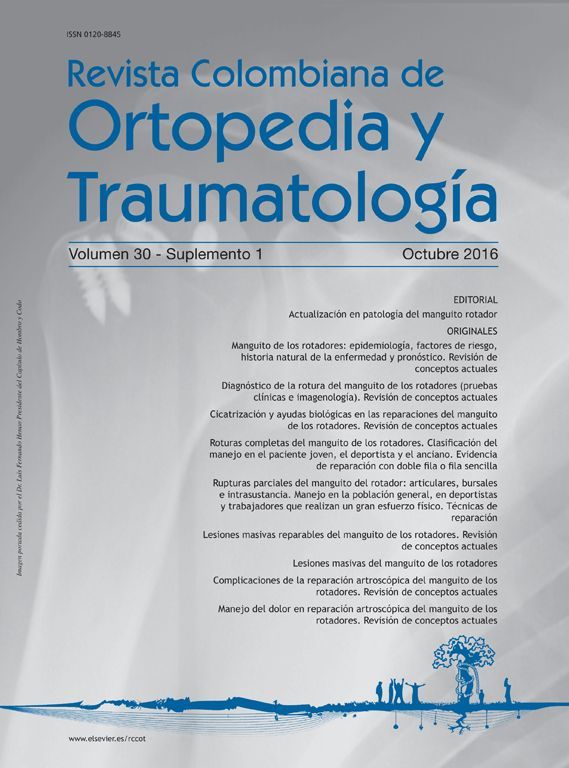
Diagnosing rotator cuff tears (clinical tests and imaging). Current concepts review
DOI:
https://doi.org/10.1016/j.rccot.2016.09.009Keywords:
Shoulder, Rotator Cuff, Injuries, Tears, Physical Examination, Clinical Tests, Imaging, DiagnosisAbstract
It is difficult to achieve an appropriate clinical diagnosis in subacromial pathology that involves the rotator cuff. It is important to recognize the following reasons: the pattern of shoulder pain is not specific to any disease; rotator cuff problems have different presentations and pathologies, rarely found isolated;the initially described clinicaltests for a specific shoulder pathology are a positive way to determine a variety of disorders, without differentiating them, and some anatomical alterations may not be symptomatic and need no treatment. The performance and interpretation of an adequate physical examination plus the use of relevant imaging aids will allow to properly approach and assess the rotator cuff pathology in order to decide the best medical-surgical option for any patient.
Downloads
References
Kibler WB, Sciascia A, Wilkes T. Scapular dyskinesis and its relation to shoulder injury. J Am Acad Orthop Surg. 2012;20:364-72.
Kibler WB, Ludewig PM, McClure PW, Michener LA, Bak K, Sciascia AD. Clinical implications of scapular dyskinesis in shoulder injury: the 2013 consensus statement from the ‘Scapular Summit’. Br J Sports Med. 2013;47:877-85.
Kuzel BR. Fatty infiltration and rotator cuff atrophy. J Am Acad Orthop Surg. 2013;21:613-23.
Hegedus EJ, Goode AP, Cook CE, Michener L, Myer CA, Myer DM, et al. Which physical examination tests provide clinicians with the most value when examining the shoulder? Update of a systematic review with meta-analysis of individual tests. Br J Sports Med. 2012;46:964-78.
Snyder S. Rotator cuff introduction, evaluation, imaging, and philosophy of repair. En: Shoulder arthroscopy. 3.a edición. Wolters Kluwer; 2015.
Codsi M. Clinical evaluation of shoulder problems. En: Rockwood C, editor. The Shoulder. 4.a edición. Philadelphia: Saunders Elsevier; 2009. p. 145-76.
Park HB, Yokota A, Gill HS, El Rassi G, McFarland EG. Diagnostic accuracy of clinical tests for the different degrees of subacromial impingement syndrome. J Bone Joint Surg Am. 2005;87:1446-55.
Michener LA, Walsworth MK, Doukas WC, Murphy KP. Reliability and diagnostic accuracy of 5 physical examination tests and combination of tests for subacromial impingement. Arch Phys Med Rehabil. 2009;90:1898-903.
Neer CS. Impingement lesions. Clin Orthop Relat Res. 1983;173:70-7.
Hawkins RJ, Kennedy JC. Impingement syndrome in athletes. Am J Sports Med. 1980;8:151-8.
King JJ. Physical examination of the shoulder. J Hand Surg Am. 2014;39:2103-12.
Tennent T. A review of the special tests associated with shoulder examination: Part I: The rotator cuff tests. Am J Sport Med. 2003;31:154-60.
Silva L. Accuracy of physical examination in subacromial impingement syndrome. Rheumatology (Oxford). 2008;47:679-83.
Cleland J. Netter’s Orthopaedic Clinic Examination. An evidence- based approach. 2.a edición Philadelphia: Elsevier; 2011.
Giacomo G. Examen físico del hombro. Cirugía artroscópica de hombro. 2010:79-110.
Jobe FW, Jobe CM. Painful athletic injuries of the shoulder. Clin Orthop Relat Res. 1983;173:117-24.
Yocum L. Assessing the shoulder. History, physical examination, differential diagnosis and special tests used. Clin Sports Med. 1983;2:281-9.
Zaslav KR. Internal rotation resistance strength test: A new diagnostic test to differentiate intra-articular pathology from outlet (Neer) impingement syndrome in the shoulder. J Shoulder Elbow Surg. 2001;10:23-7.
Kelly BT, Kadrmas WR, Speer KP. The manual muscle examination for rotator cuff strength. An electromyographic investigation. Am J Sports Med. 1996;24:581-8.
Itoi E, Kido T, Sano A, Urayama M, Sato K. Which is more useful, the ‘‘full can test’’ or the ‘‘empty can test’’, in detecting the torn supraspinatus tendon? Am J Sports Med. 1999;27:65-8.
Malanga GA, Jenp YN, Growney ES, An KN. EMG analysis of shoulder positioning in testing and strengthening the supraspinatus. Med Sci Sports Exerc. 1996;28:661-4.
Leroux JL, Thomas E, Bonnel F, Blotman F. Diagnostic value of clinical tests for shoulder impingement syndrome. Rev Rhum Engl Ed. 1995;62:423-8.
Walch G, Liotard JP, Boileau P, Noël E. Postero-superior glenoid impingement. Another impingement of the shoulder. J Radiol. 1993;74:47-50.
Boettcher CE, Ginn KA, Cathers I. The ‘empty can’ and ‘full can’ tests do not selectively activate supraspinatus. J Sci Med Sport. 2009;12:435-9.
Lin L. Internal rotation resistance test at abduction and external rotation: a new clinical test for diagnosing subscapularis lesions. Knee Surg Sports Traumatol Arthrosc. 2015;23:1247-52.
VP JR, Burkhart SS, De Beer JF. The Bear-Hug test: a new and sensitive test for diagnosing a subscapularis tear. Arthroscopy. 2006;22:1076-84.
Bartsch M, Scheibel M. Diagnostic values of clinical tests for subscapularis lesions. Knee Surg Sports Traumatol Arthrosc. 2010;18:1712-7.
Bennett WF. Subscapularis, medial, and lateral head coracohumeral ligament insertion anatomy. Arthroscopic appearance and incidence of ‘‘hidden’’ rotator interval lesions. Arthroscopy. 2001;17:173-80.
Longo UG, Berton A, Marinozzi A, Maffulli N, Denaro V. Subscapularis tears. Med Sport Sci. 2012;57:114-21.
Lafosse L, Jost B, Reiland Y, Audebert S, Toussaint B, Gobezie R. Structural integrity and clinical outcomes after arthroscopic repair of isolated subscapularis tears. J Bone Joint Surg Am. 2007;89:1184-93.
Kim TK, Rauh PB, McFarland EG. Partial tears of the subscapularis tendon found during arthroscopic procedures on the shoulder: a statistical analysis of sixty cases. Am J Sports Med. 2003;31:744-50.
Warth JR, Millett PJ. Rotator cuff disorders. En: Warth JR, Millett PJ, editores. Physical examination of the shoulder. An evidence-based approach. Nueva York: Springer; 2015.
Srour F, Dumontier C, Louvière M, Barrette G. Evaluación clínica y funcional del hombro doloroso. Kinesiterapia-Medicina Física. 2013;34:1-21.
Gerber C, Krushell RJ. Isolated rupture of the tendon of the subscapularis muscle. Clinical features in 16 cases. J Bone Joint Surg Br. 1991;73:389-94.
Hertel R, Ballmer FT, Lombert SM, Gerber C. Lag signs in the diagnosis of rotator cuff rupture. J Shoulder Elbow Surg. 1996;5:307-13.
Scheibel M, Magosch P, Pritsch M, Lichtenberg S, Habermeyer P. The belly-off sign: a new clinical diagnostic sign for subscapularis lesions. Arthroscopy. 2005;21:1229-35.
Burkhart SS, Tehrany AM. Arthroscopic subscapularis tendon repair: technique and preliminary results. Arthroscopy. 2002;18:454-63.
Barth J, Audebert S, Toussaint B, Charousset C, Godeneche A, Graveleau N. Diagnosis of subscapularis tendon tears: Are available diagnostic tests pertinent for a positive diagnosis? Orthop Traumatol Surg Res. 2012;98:S178-85.
Jain NB, Wilcox RB 3rd, Katz JN, Higgins LD. Clinical examination of the rotator cuff. PM R. 2013;5:45-56.
Gerber C, Hersche O, Farron A. Isolated rupture of the subscapularis tendon. J Bone Joint Surg Am. 1996;78:1015-23.
Barth JR, Burkhart SS, De Beer JF. The bear-hug test: a new and sensitive test for diagnosing a subscapularis tear. Arthroscopy. 2006;22:1076-84.
Wani Z. Rotator cuff tears: Review of epidemiology, clinical assessment and operative treatment. Trauma. 2016;18:190-204.
Bennett WF. Arthroscopic repair of isolated subscapularis tears: a prospective cohort with 2- to 4-year follow-up. Arthroscopy. 2003;19:131-43.
Bartl C, Salzmann GM, Seppel G, Eichhorn S, Holzapfel K, Wortler K, et al. Subscapularis function and structural integrity after arthroscopic repair of isolated subscapularis tears. Am J Sports Med. 2011;39:1255-62.
Bartsch M, Greiner S, Haas NP, Scheibel M. Diagnostic values of clinical tests for subscapularis lesions. Knee Surg Sports Traumatol Arthrosc. 2010;18:1712-7.
Kuhn JE. Rotator cuff tears; Classification and diagnosis. En: Miniaci A, editor. Disorders of the shoulder: Diagnosis and management. Sports injuries. Wolters Kluwer-Williams & Wilkins; 2014.
Chao S. An electromyographic assessment of the ‘‘bear hug’’: An examination for the evaluation of the subscapularis muscle. Arthroscopy. 2008;24:1265-70.
Tokish JM, Decker MJ, Ellis HB, Torry MR, Hawkins RJ. The belly-press test for the physical examination of the subscapularis muscle: electromyographic validation and comparison to the lift-off test. J Shoulder Elbow Surg. 2003;12:427-30.
Kim SH, Oh I, Park JS, Shin SK, Jeong WK. Intra-articular repair of an isolated partial articular-surface tear of the subscapularis tendon. Am J Sports Med. 2005;33:1825-30.
Yoon J. Diagnostic value of four clinical test for evaluation of subscapularis integrity. J Shoulder Elbow Surg. 2013;22:1186-92.
Takeda Y, Fujii K, Miyatake K, Kawasaki Y, Nakayama T, Sugiura K. Diagnostic value of the supine Napoleon test for subscapularis tendon lesions. Arthroscopy. 2016, http://dx.doi.org/10.1016/j.arthro.2016.04.034. Jun 24. pii: S0749-8063(16)30244-4. [Epub ahead of print].
Codman EA. The shoulder: rupture of the supraspinatus tendon and other lesions in or about the sub-acromial bursa. Boston: Thomas Todd; 1934. p. 123-77.
Ponce BA, Kundukulam JA, Sheppard ED, Determann JR, McGwin G, Narducci CA, et al. Rotator cuff crepitus: could Codman really feel a cuff tear? J Shoulder Elbow Surg. 2014;23:1017-22.
Marreez Y. Physical examination of the shoulder joint-Part I: Supraspinatus rotator cuff muscle clinical testing. Osteopath Fam Physician. 2013;5:128-34.
Woodward TW, Best TM. The painful shoulder: Part I. Clinical evaluation. Am Fam Physician. 2000;61:3079-88.
Lasbleiz S, Quintero N, Ea K, Petrover D, Aout M, Laredo JD. Diagnosis value of clinical test for degenerative rotator cuff disease in medical practice. Ann Phys Rehab Med. 2014;57:228-43.
Cameron BD, Williams GR Jr, Iannotti JP. Disorders of the shoulder: Diagnosis and management, Vol1, 2.a edición Philadelphia: Lippincott Williams & Wilkins; 2007.
Walch G. The ‘‘drop ping and ‘‘hornblower’s’’ signs in evaluation of rotator cuff tears. J Bone Joint Surg Br. 1998;80:624-8.
Somerville LE. Clinical assessment of physical examination maneuvers for rotator cuff lesions. Am J Sports Med. 2014;42:1911-9.
Kim E, Jeong HJ, Lee KW, Song JS. Interpreting positive signs of the supraspinatus test in screening for torn rotator cuff. Acta Med Okayama. 2006;60:223-38.
Castoldi F, Blonna D, Hertel R. External rotation lag sign revisited: accuracy for diagnosis of full thickness supraspinatus tear. J Shoulder Elbow Surg. 2009;18:529-34.
Collin P. What is the best clinical test for assessment of the teres minor in massive rotator cuff tears? Clin Orthop Relat Res. 2015;473:2959-66.
Murrell GAC, Walton JR. Diagnosis of rotator cuff tears. Lancet. 2001;357:769---70. Erratum in: Lancet. 2001;357:1452.
Miller CA, Forrester GA, Lewis JS. The validity of the lag signs in diagnosing full-thickness tears of the rotator cuff: a preliminary investigation. Arch Phys Med Rehabil. 2008;89:1162-8.
Kuzel B. Fatty infiltration and rotator cuff atrophy. J Am Acad Orthop Surg. 2013;21:613-23.
de Jesus JO, Parker L, Frangos AJ, Nazarian LN. Accuracy of MRI, MR arthrography, and ultrasound in the diagnosis of rotator cuff tears: a meta-analisis. AJR Am J Roentgenol. 2009;192:1701-7.
Viychou M. Symptomatic partial rotator cuff tears: diagnosis performance of ultrasound and magnetic resonance imaging with surgical correlation. Acta Radiol. 2009;50:101-5.
Fotiadou AN. Ultrasonography of symptomatic rotator cuff tears compared with MR imaging and surgery. Eur J Radiol. 2008;68:174-9
Sipola P. Detection and quantification of rotator cuff tears with ultrasonography and magnetic resonance imaging- a prospective study in 77 consecutive patients with a surgical reference. Ultrasound Med Biol. 2010;36:1981-9.
Tuite M. Magnetic resonance imaging of rotator cuff disease and external impingement. Magn Reson Imaging Clin N Am. 2012;20:187-200.
Theodoropoulos JS. Magnetic resonance imaging and magnetic resonance arthrography of the shoulder: dependence on the level of training of the performing radiologist for diagnostic accuracy. Skeletal Radiol. 2010;39:661-7.
Van Dyck P, Gielen JL, Veryser J, Weyler J, Vanhoenacker FM, Van Glabbeek F. Tears of the supraspinatus tendon: assessment with indirect magnetic resonance arthrography in 67 patients with arthroscopic correlation. Acta Radiol. 2009;50:1057-63.
Jung JY, Jee WH, Chun HJ, Ahn MI, Kim YS. Magnetic resonance arthrography including ABER view in diagnosing partial-thickness tears of the rotator cuff: accuracy and inter and intra observer agreements. Acta Radiol. 2010;51:194-201.
Herold T. Indirect MR arthrography of the shoulder: use of abduction and external rotation to detect full and partial thickness tears of the supraspinatus tendon. Radiology. 2006;240:152-60.
Downloads
Published
How to Cite
Issue
Section
License
Copyright (c) 2025 Sociedad Colombiana de Cirugía Ortopédica y Traumatología.

This work is licensed under a Creative Commons Attribution 4.0 International License.
| Article metrics | |
|---|---|
| Abstract views | |
| Galley vies | |
| PDF Views | |
| HTML views | |
| Other views | |