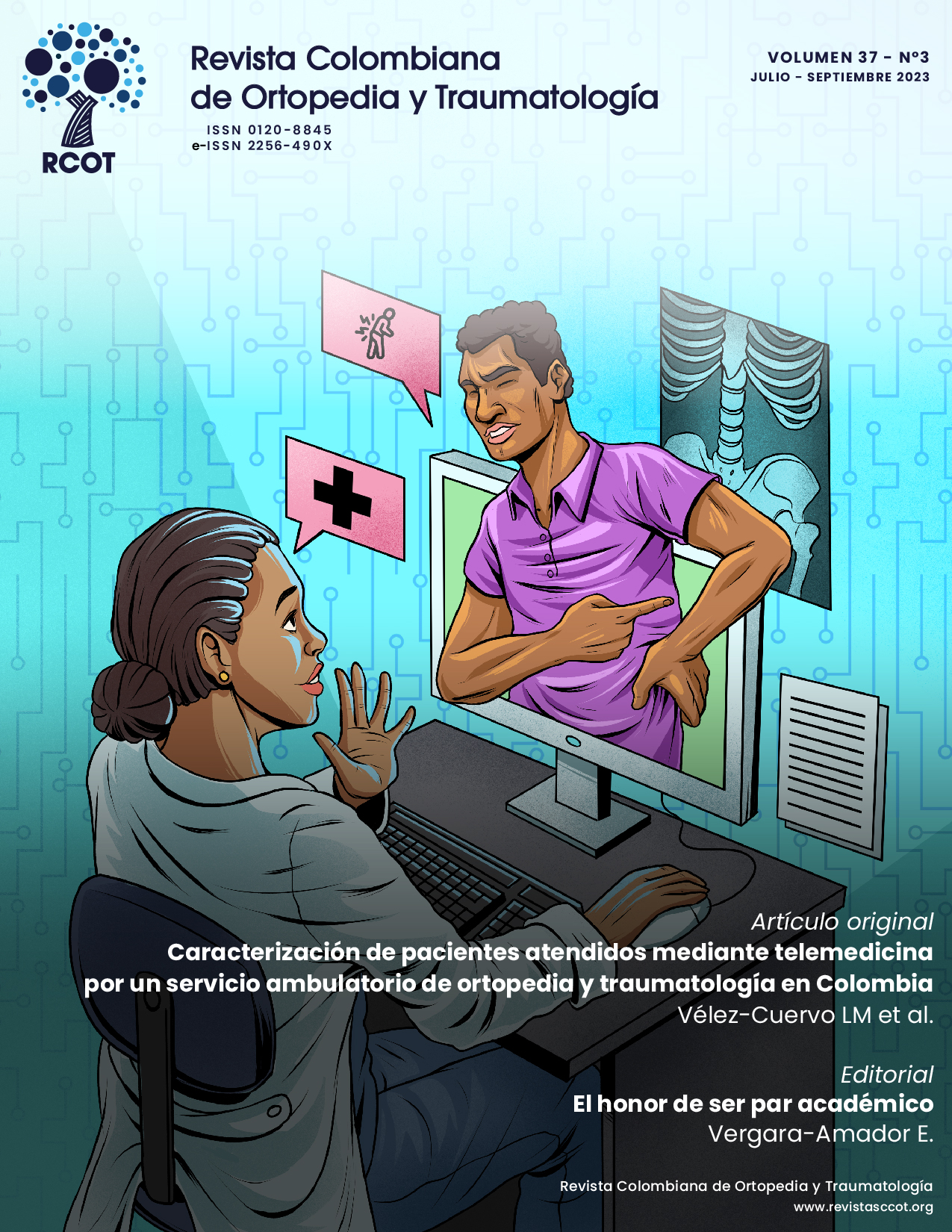
Characterization of patients receiving telemedicine care by an outpatient orthopedics and trauma service in Colombia
DOI:
https://doi.org/10.58814/01208845.33Keywords:
Telemedicine, Remote consultation, Orthopedics, TechnologyAbstract
Introduction: Telemedicine consultation is a health care strategy that uses information and communication technologies to improve access to health services, mainly for people located in geographic areas that are far from the place of care or have difficulties in traveling.
Objective: To describe the sociodemographic and clinical characteristics of patients from the department of Chocó (Colombia) served between January and May 2020 by the orthopedics and traumatology service using telexpertise, as well as the opportunity times and the possibility of making clinical decisions during the consultation.
Methodology: A retrospective descriptive study was carried out on 70 patients with non-traumatic musculoskeletal conditions who, between January and May 2020, and by means of synchronous telexpertise (video call), received specialized care from the orthopedics and trauma service of a digital hospital during a consultation with a general practitioner in a secondary care hospital in Chocó. This strategy was evaluated in terms of timeliness and the possibility of making clinical decisions during the consultation.
Results: 78.57% of the patients were able to continue to receive telemedicine health care after the consultation. Additionally, during the consultation, 10% of these patients were prescribed with infiltration or surgical procedures, while referral for face-to-face consultation with a specialist was requested for 8.57% of the patients. During the telexpertise consultation, therapeutic decisions were made in 91.43% of the patients.
Conclusion: Based on our findings, it can be stated that synchronous telexpertise care can be used in areas where complex geographical conditions and the lack of specialists restrict access to health services, since it allows making timely therapeutic decisions.
Downloads
References
Gaspar-Calvo E, Lallana MJ, Maldonado L, Aguilar-Palacio I, Castel-Feced S, Rabanaque MJ, et al. Enfermedad musculoesquelética en población trabajadora : perfil de los afectados y manejo farmacológico. Rev. Asoc. Esp. Espec. Med. Trab. 2023;31(4):9-22.
Vargas JJ, Molina MG. Acceso a los servicios de salud en seis ciudades de Colombia: limitaciones y consecuencias. Rev Fac. Nac. Salud Pública. 2009;27(2):121-30.
Bran Piedrahita L, Valencia Arias A, Palacios Moya L, Gómez Molina S, Acevedo Correa Y, Arias Arciniegas C. Barreras de acceso del sistema de salud colombiano en zonas rurales: percepciones de usuarios del régimen subsidiado. Hacia promoc. Salud. 2020;25(2):29-38. https://doi.org/grp78p.
Colombia. Ministerio de Salud. Resolución 2654 de 2019 (octubre 3): Por la cual se establecen disposiciones para la telesalud y parámetros para la práctica de la telemedicina en el país. Bogotá D.C.; octubre 3 de 2019 [cited 2023 Sep 6]. Available from: https://bit.ly/3PrdIKZ.
Tuckson RV, Edmunds M, Hodgkins ML. Telehealth. N. Engl. J. Med. 2017; 377(16):1585-92.
Prada C, Izquierdo N, Traipe R, Figueroa C. Results of a new telemedicine strategy in traumatology and orthopedics. Telemed J. E. Health. 2020;26(5):665-70. https://doi.org/kt8t.
Buvik A, Bergmo TS, Bugge E, Smaabrekke A, Wilsgaard T, Olsen JA. Cost-effectiveness of telemedicine in remote orthopedic consultations: Randomized controlled trial. J. Med. Internet Res. 2019;21(2):e11330. https://doi.org/gf7c3q.
Colombia. Congreso de la República de Colombia. Ley 2015 de 2020 (enero 31): Por medio de la cual se crea la historia clínica electrónica interoperable y se dictan otras disposiciones. Bogotá, D.C.; enero 31 de 2020 [cited 2023 Sep 6]. Available from: https://bit.ly/3PreoA1.
Colombia. Ministerio de Salud. ABECÉ Interoperabilidad de Datos de la Historia Clínica en Colombia - Términos y siglas. Bogotá D.C.;2019 [cited 2023 Sep 06]. Avaliable from: https://bit.ly/3ZP3yst.
World Medical Asociation (WMA). WMA Declaration of Helsinki – Ethical principles for medical research involving human subjects. Fortaleza: 64th WMA General Assembly; 2013.
National Commission for the Protection of Human Subjects of Biomedical and Behavioral Research. The Belmont Report: Ethical Principles and Guidelines for the Protection of Human Subjects of Research. Maryland; 1979. Available from: https://bit.ly/46tYtZg.
Colombia. Ministerio de Salud. Resolución 8430 de 1993 (octubre 4): Por la cual se establecen las normas científicas, técnicas y administrativas para la investigación en salud. Bogotá D.C.; octubre 4 de 1993 [cited 2023 Sep 06]. Available from: https://bit.ly/31gu7do.
Cáceres-Méndez EA, Castro-Díaz SM, Gómez-Restrepo C, Puyana JC. Telemedicina: historia, aplicaciones y nuevas herramientas en el aprendizaje. Univ. Méd. Bogotá (Colombia). 2011;52(1):11-35.
Catalán-Matamoros D, López-Villegas A. La Telesalud y la sociedad actual: retos y oportunidades = Telehealth and the current society: challenges and opportunities. Rev. Esp. Comun Salud. 2016;7(2):336-45. https://doi.org/kt8v.
Correa-Díaz AM. Avances y barreras de la telemedicina en Colombia. Rev. Fac. Derecho Cienc. Polít. 2017;47(127):361-82. https://doi.org/kt8w.
Vaccaro AR, Getz CL, Cohen BE, Cole BJ, Donnally CJ. Practice Management during the COVID-19 Pandemic. J. Am. Acad. Orthop. Surg. 2020;28(11):464-70. https://doi.org/ggr6t8.
Calixto B LF, Camacho F, Vergara A EM, Torres R F, Mahecha T MT, González J, et al. Manejo de pacientes de Ortopedia y Traumatología en el contexto de la contingencia por Covid-19: revisión de conceptos actuales revisión de la literatura. Rev. Colomb. Ortop. y Traumatol. 2021;35(1):26–34. https://doi.org/kt8x.
The Bellagio eHealth Evaluation Group. Call to Action on Global eHealth Evaluation: Consensus Statement of the World Health Organization (WHO) Global eHealth Evaluation Meeting. Beltagio;2011. Available from: https://bit.ly/3LZfz9b.
Labrique A, Vasudevan L, Weiss W, Wilson K. Establishing standards to evaluate the impact of integrating digital health into health systems. Glob. Heal. Sci. Pract. 2018;6(Suppl 1):S5-17. https://doi.org/kt8z.
World Health Organization (WHO). Global strategy on digital health 2020-2025. Ginebra; 2021. Available from: https://bit.ly/3ZQIYb8.
Buvik A, Bugge E, Knutsen G, Småbrekke A, Wilsgaard T. Patient satisfaction with remote orthopaedic consultation by using telemedicine: A randomised controlled trial. J. Telemed. Telecare. 2019;25(8):451-9. https://doi.org/gdsn9x.
Sathiyakumar V, Apfeld JC, Obremskey WT, Thakore RV, Sethi MK. Prospective randomized controlled trial using telemedicine for follow-ups in an orthopedic trauma population: A pilot study. J. Orthop. Trauma. 2015;29(3):e139-45. https://doi.org/f626gf.
Vuolio S, Winblad I, Ohinmaa A, Haukipuro K. Videoconferencing for orthopaedic outpatients: One-year follow-up. J. Telemed. Telecare. 2003;9(1):8-11. https://doi.org/cxjvxv.
Jennett PA, Affleck Hall L, Hailey D, Ohinmaa A, Anderson C, Thomas R, et al. The socio-economic impact of telehealth: A systematic review. J Telemed Telecare. 2003;9(6):311-20. https://doi.org/dtb8m6.
Caffery LJ, Taylor M, North JB, Smith AC. Tele-orthopaedics: A snapshot of services in Australia. J. Telemed. Telecare. 2017;23(10):835-41. https://doi.org/gch26p.
Aarnio P, Lamminen H, Lepistö J, Alho A. A prospective study of teleconferencing for orthopaedic consultations. J. Telemed. Telecare. 1999;5(1):62-6. https://doi.org/c8429p.
Downloads
Published
How to Cite
Issue
Section
License
Copyright (c) 2023 The Author(s).

This work is licensed under a Creative Commons Attribution 4.0 International License.
| Article metrics | |
|---|---|
| Abstract views | |
| Galley vies | |
| PDF Views | |
| HTML views | |
| Other views | |