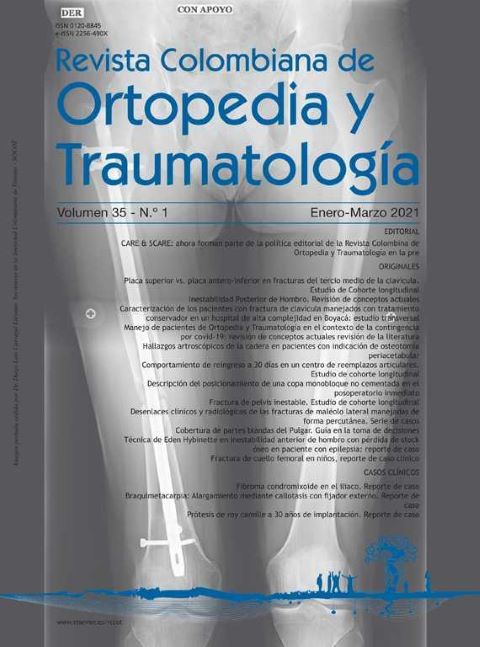
Unstable pelvic Fractures. A Cohort Study
DOI:
https://doi.org/10.1016/j.rccot.2021.01.005Keywords:
pelvic fracture, trauma, bleeding control, mortality, risk factors, institutional pelvis protocol, angioembolizationAbstract
Background: There is no consensus about treatment for patients with an unstable pelvic fracture and even less when hemodynamic instability is associated with. Study was conducted to determine the outcome in the management of patients with an unstable fracture of the pelvis, with or without hemodynamic instability, in a trauma referral center in Medellín, Colombia.Methods: A retrospective, longitudinal cohort study was conducted including patients with pelvic fracture due to trauma. Demographic data, vital signs on admission, presence of hemodynamic shock on admission (according to the ATLS scale), method of bleeding control, transfusion requirement and overall mortality rate were collected. An analysis was performed on a subgroup of patients who presented with signs of associated severe hemodynamic shock, defined as ATLS III-IV upon admission and a requirement for blood products of more than 8IU in the first 48 hours.
Results: A total of 567 patients with any type of pelvic fracture, between January 2011 and December 2018, identified in the institution’s databases, of which 149 patients presented an unstable pelvic fracture pattern (FIP). 68.1% of the patients were male, with a mean age of 34 IQR; 30 years and an Injury Severity Score (ISS) of 34 IQR: 20. Hospital mortality was 13.3%. Angioembolization and external fixator placement were the most used method of bleeding control. A total of 37 patients (27%) underwent intervention to control bleeding in the first 48 hours. There were 37 patients with pelvic fracture admitted in a state of severe shock or requiring more than 8U of blood products, 17 patients required intervention in the pelvis, using single or combined ways. The mortality calculated for these patients was 32%.
Discussion: Patients with unstable pelvis fractures admitted to our institution have a high mortality rate and it is even higher in patients who present with severe shock. Various methods were used to control bleeding similar to those indicated in the current literature. We require a sustained institutional effort to treat pelvic fractures and reduce the mortality of our patients, and knowing our population characteristcs allows us to guide management strategies.
Evidence Level: III
Downloads
References
Costantini TW, Coimbra R, Holcomb JB, Podbielski JM, Catalano R, Blackburn A, et al. Current management of hemorr- hage from severe pelvic fractures: Results of an American Association for the Surgery of Trauma multi-institutional trial. J Trauma Acute Care Surgery. 2016;80:717-23, https://doi.org/10.1097/TA.0000000000001034
Hauschild O, Strohm PC, Culemann U, Pohlemann T, Suedkamp NP, Koestler W, Schmal H. Mortality in patients with pelvic fractures: results from the Ger- man pelvic injury register. J Trauma. 2008;64:449-55, https://doi.org/10.1097/TA.0b013e31815982b1
Demetriades D, Karaiskakis M, Toutouzas K, Alo K, Velmahos G, Chan L. Pelvic fractures. Epidemio- logy and predictors of associated abdominal injuries and outcomes. J Am Coll Surg. 2002 Jul;195:1-10, https://doi.org/10.1016/S1072-7515(02)01197-3
Munera L, Velazquez RD. Mortalidad asociada a las fracturas de la pelvis. Medicina UPB, noviembre. 1987;6(2.).
Butcher N, Balogh ZJ. The definition of polytrauma: the need for international consensus. Injury. 2009;40(S4):S12-22, https://doi.org/10.1016/j.injury.2009.10.032
Schulman JE, O'Toole RV, Castillo RC, et al. Pel- vic ring fractures are an independent risk factor for death after blunt trauma. J Trauma. 2010;68:930-4, https://doi.org/10.1097/TA.0b013e3181cb49d1
Yoshihara H, Yoneoka D. Demographic epidemiology of unsta- ble pelvic fracture in the United States from 2000 to 2009: trends and in-hospital mortality. J Trauma Acute Care Surg. 2014;76:380-5. https://doi.org/10.1097/TA.0b013e3182ab0cde
Magnone S, Coccolini F, Manfredi R, Piazzalunga D, Agazzi R, Arici C, et al. Management of hemodynamically unstable pel- vic trauma: results of the first Italian consensus conference (cooperative guidelines of the Italian Society of Surgery, the Italian Association of Hospital Surgeons, the Multi-specialist Italian Society of Young Surgeons, the Italian Society of Emergency Surgery and Trauma, the Italian Society of Anesthesia, Analgesia, Resuscitation and Intensive Care, the Italian Society of Orthopaedics and Traumatology, the Italian Society of Emergency Medicine, the Italian Society of Medical Radiology - Section of Vascular and Interventional Radiology- and the World Society of Emergency Surgery). World J Emerg Surg. 2014;9:18, https://doi.org/10.1186/1749-7922-9-18
Cullinane DC, Schiller HJ, Zielinski MD, Bilaniuk JW, Collier BR, Como J, Holevar M, Sabater EA, Sems SA, Vassy WM, et al. Eastern Association for the Surgery of Trauma practice mana- gement guidelines for hemorrhage in pelvic fracture-update and systematic review. J Trauma. 2011;71:1850-68, https://doi.org/10.1097/TA.0b013e31823dca9a
Schwartz DA, Medina M, Cotton BA, Rahbar E, Wade CE, Cohen AM, Beeler AM, Burgess AR, Holcomb JB. Are we deli- vering two standards of care for pelvic trauma? Availability of angioembolization after hours and on weekends increases time to therapeutic intervention. J Trauma Acute Care Surg. 2014;76:134-9. https://doi.org/10.1097/TA.0b013e3182ab0cfc
Vallier HA, Moore TA, Como JJ, et al. Teamwork in Trauma: System Adjustment to a Protocol for the Management of Multiply Injured Patients. J OrthopTrauma. 2015;29:446-50, https://doi.org/10.1097/BOT.0000000000000383
Alton TB, Gee AO. Classifications in brief: young and burgess classification of pelvic ring injuries. Clin Orthop Relat Res. 2014;472:2338-42, https://doi.org/10.1007/s11999-014-3693-8
Coccolini F, Stahel PF, Montori G, et al. Pelvic trauma: WSES classification and guidelines. World J Emerg Surg. 2017;12:5, https://doi.org/10.1186/s13017-017-0117-6 Published 2017 Jan 18.
Butcher, Nerida EMD, D'Este, Catherine PhD, Balogh, Zsolt JMDPhD. The quest for a universal definition of polytrauma: A trauma registry-based validation study. Journal of Trauma and Acute Care Surgery:. October 2014;77:620-3, https://doi.org/10.1097/TA.000000000000040
Tosounidis TI, Giannoudis PV. Pelvic fractures pre- senting with haemodynamic instability: treatment options and outcomes. Surgeon. 2013;11:344-51, https://doi.org/10.1016/j.surge.2013.07.004
Committee of trauma of, ACS., Advanced Trauma Life Support (ATLS) Student manual 9th ed. ACS. Chicago. 2012.
Vallier HA, Wang X, Moore TA, Wilber JH, Como JJ. Timing of orthopaedic surgery in multiple trauma patients: development of a protocol for early appro- priate care. J Orthop Trauma. 2013;27:543-51, https://doi.org/10.1097/BOT.0b013e31829efda1
Abrassart S, Stern R, Peter R. Unstable pelvic ring injury with hemodynamic instability: what seems the best procedure choice and sequence in the initial management? Orthopaedics & Traumatology, Surgery & Research: OTSR. 2013 Apr;99:175-82, https://doi.org/10.1016/j.otsr.2012.12.014
Black SR, Sathy AK, Jo C, Wiley MR, Minei JP, Starr AJ. Improved Survival After Pelvic Fracture: 13-Year Expe- rience at a Single Trauma Center Using a Multidiscipli- nary Institutional Protocol. J Orthop Trauma. 2016;30:22-8, https://doi.org/10.1097/BOT.0000000000000443
Stahel PF, Burlew CC, Moore EE. Current trends in the management of hemodynamically unstable pel- vic ring injuries. Curr Opin Crit Care. 2017;23:511-9, https://doi.org/10.1097/MCC.0000000000000454
Stein DM, O'Toole R, Scalea TM. Multidisciplinary approach for patients with pelvic fractures and hemodynamic instability. Scand J Surg. 2007;96:272-80.
https://doi.org/10.1177/145749690709600403
Tonetti J. Management of recent unstable fractures of the pelvic ring An update conference supported by the Club Bassin Cotyle. (Pelvis-Acetabulum Club). Orthop Traumatol Surg Res. 2013;99 1 Suppl:S77-86, https://doi.org/10.1016/j.otsr.2012.11.013
Downloads
Published
How to Cite
Issue
Section
License
Copyright (c) 2024 Sociedad Colombiana de Cirugía Ortopédica y Traumatología.

This work is licensed under a Creative Commons Attribution 3.0 Unported License.
| Article metrics | |
|---|---|
| Abstract views | |
| Galley vies | |
| PDF Views | |
| HTML views | |
| Other views | |